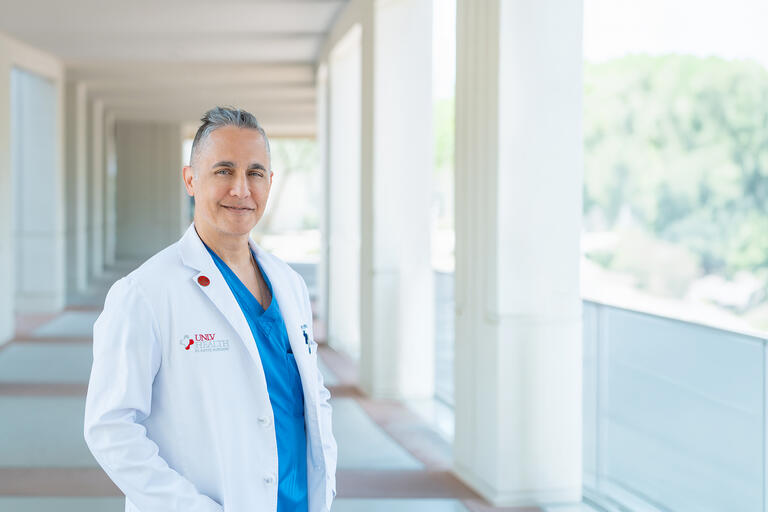
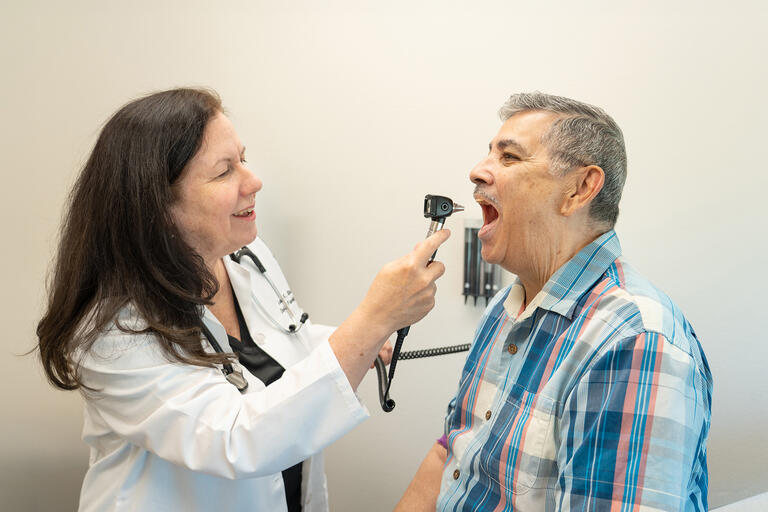
With the common goal of improving access to care for uninsured and underserved members of the community, the Kirk Kerkorian School of Medicine at UNLV launched the UNLV Community Clinic (UCC) in collaboration with Volunteers in Medicine of Southern Nevada (VMSN), which provides clinic space and ongoing support.
The UCC is a student-led initiative through the Kirk Kerkorian School of Medicine at UNLV, underpinned by volunteer faculty physicians with clinic sessions held at Volunteers in Medicine of Southern Nevada. These clinic sessions primarily focus on providing free primary care services – including routine checkups, health screenings, chronic disease management, and select specialty services for uninsured and underserved patients.
As manager of the UCC, Mariela Perez, who earned her bachelor's in philosophy from UNLV, works closely with students, faculty, and VMSN to ensure the clinic runs smoothly. She supports the volunteers, coordinates clinic operations, organizes trainings, and helps students feel prepared and supported during their shifts at the UCC. For Perez, it has been exciting to see the UCC grow into a space where students can learn and patients can receive care in a welcoming and supportive environment.
Dr. Elissa Palmer, professor and chair of the department of family and community medicine, oversees the UCC. Like Perez, she is deeply committed to integrating education with service, working in close partnership with attending faculty, especially in primary care, to cultivate a clinical environment rooted in empathy and patient-centered care.
She ensures that students receive early exposure to authentic clinical experiences and that, irrespective of their assigned roles, all learners participate in case discussions with attending physicians. “It is such an enjoyable time. This approach promotes active learning, interdisciplinary collaboration, and meaningful faculty-student engagement,” says Dr. Palmer.

Shifts at the UCC strongly emphasize teamwork, with each shift consisting of at least two teams. Each team includes an attending physician; when available, a resident physician; a student doctor; a medical assistant; a scribe; and an interpreter. All roles, minus the roles of attending physician and resident physician, are fulfilled by medical students. Depending on the role, the students’ responsibilities can vary.
Perez says, “They may help check patients in, room patients, take vitals, document visits, interpret, or speak with patients about their concerns and care plans. Faculty members supervise patient care, answer questions, and help guide students throughout the clinic session.”
The ability to observe how students interact with patients during UCC sessions has been a meaningful experience for Perez. “Patients are often very grateful for the care they receive and regularly share positive feedback about their experience, especially when students are willing to speak Spanish with them,” Perez says. “I remember one patient thanking a student while scheduling their next appointment because the student spoke Spanish to them. The patient was genuinely appreciative of the student's effort.”
Perez also recalls another time in which a student helped a patient through a difficult situation. “The student doctor sat beside the patient, listened to what she had to say, and gave her the time and space to talk. By the end of the conversation, the patient smiled and thanked the student for listening,” she says. “Although it was a difficult moment, it was also a reminder that patients often just want to feel heard, supported, and understood.”
The significant impact the clinic has on the local community and the people who volunteer there is undeniable. “For many patients, it provides access to healthcare that they may not otherwise receive. It also gives patients the opportunity to build relationships with providers, receive support for managing chronic conditions, and better understand their health,” Perez says. “For students, the clinic provides valuable hands-on experience early in their training. It gives them the opportunity to work directly with patients, build communication skills, and learn how to work as part of a healthcare team. For faculty, residents, and other volunteers, it is an opportunity to mentor students, give back to the community, and be part of a mission to improve access to care in Southern Nevada.”
And the best part, the UCC is here to stay. Since the clinic’s inception, sustainability has been a top priority, making it a reliable resource for the community. “We built the infrastructure very purposefully and very deliberately because we didn't want this to be some project that started and then ended, so sustainability was incredibly important,” Palmer says. “We've had some grant funds here and there to be able to get it started, to continue on with it, but we needed to make sure that we built it and incorporated it into the school of medicine so that should we not have additional funds, that all of these things can continue.”
As for the UCC’s vision for the future, Perez says, “The UCC aims to provide compassionate, high-quality care to patients while helping students build confidence, communication skills, and hands-on clinical experience early in their training. The clinic also hopes to continue strengthening its collaboration with Volunteers in Medicine of Southern Nevada, grow student involvement, and expand the ways it can support both patients and volunteers in the future.”
Current funding to help offset some expenses of the UCC is provided by a portion of the Nevada Primary Care Touchpoints Education Program Grant. Certain requirements must be met to become a patient at the UCC. Individuals cannot have any insurance, including Nevada Health Link, Nevada Check Up, Medicaid, Medicare, or Veterans Affairs (VA) benefits.