The anatomical education program at The Kirk Kerkorian School of Medicine combines state-of-the-art facilities with innovative curriculum design. The program, housed in the 135,000-square-foot medical education building and made possible through the generosity of the Nevada Health and Bioscience Corporation, offers students access to human body dissection, plastinated specimens, virtual reality platforms, and digital anatomy tools.
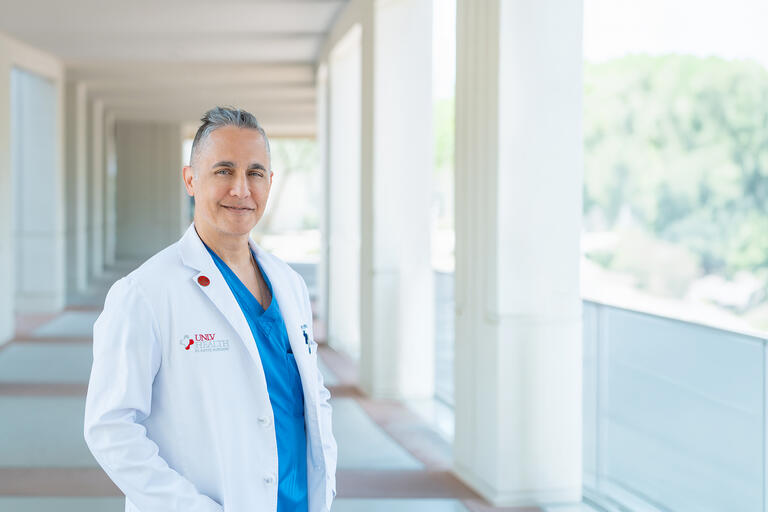
Since joining UNLV in 2023, Aftab Merchant, MBBS, FCPS, professor of medical education and assistant dean for anatomical education, has led a transformation of anatomical sciences at the school, building on his prior role as discipline lead for anatomy across the three campuses of the University of Illinois College of Medicine. At UNLV, he has drawn on his expertise in curriculum design and educational leadership to create a program that blends traditional dissection with technology-enhanced learning.
Reflecting on the program's evolution, Merchant explains: "We moved from a virtual-only model to a curriculum where students can learn anatomy through human body dissection, plastinated specimens, and immersive technologies. More importantly, our focus is on clinically relevant anatomy – teaching students the knowledge and skills that will directly support their careers as future physicians. This balance helps them not only master anatomy, but also develop compassion, professionalism, and confidence in applying what they learn to patient care."
The anatomy team has integrated anatomy into the curriculum alongside cross-sectional anatomy, radiology, histology, and embryology, revitalized neuroscience instruction, and developed a fourth-year clinical anatomy elective. The program has expanded the use of plastinated specimens and anatomical models and upgraded the audiovisual facilities in the anatomy lab to enrich the learning environment. Together, these efforts have helped position the school of medicine as a model of how tradition and technology can be blended for maximal impact.
The program’s success is due in large part to a dedicated team that has driven its growth and innovation. Owen McCloskey, who initially served as anatomy lab manager, is now director of the anatomy lab and the anatomical gift program, ensuring the long-term sustainability of donor-based education. Additionally, numerous clinical faculty members contribute to teaching, enriching student learning with real-world perspectives.
Students are introduced to the dissection lab with an emphasis on professionalism, compassion, and respect for donors. They progress from guided prosection labs to hands-on dissection, gaining experience in understanding human variation and tissue handling. Outside the lab, they learn through plastinated specimens, round-the-clock access to Sectra [virtual anatomy] tables, and immersive virtual reality dissections. Students conclude their anatomy experience with the Service of Gratitude ceremony, an entirely student-led event honoring the donors whose anatomical gifts made their education possible.
The program extends beyond medical students. The Summer Anatomy Seminar, launched in 2025, offers pre-medicine undergraduates hands-on experience with human donor specimens, simulation-based clinical experiences, and advanced technologies such as virtual reality to explore complex concepts in a clinical context. It also creates opportunities to connect with medical students and faculty while exploring careers in the health sciences. Beyond undergraduate and medical student training, the anatomy facilities offer residents and clinical faculty opportunities to learn and refine procedural skills. In partnership with the simulation center, the program supports learners at every level, from pre-medical students to residents and practicing clinicians.
With plans for an anatomical gift program, which would be the first in Southern Nevada, and continued investment in facilities and curriculum, the anatomical education program is on a trajectory of continued growth. As Interim Dean Alison Netski, MD, notes: "We are continuously looking for ways to improve the educational experience. Our students have always performed well, often meeting or exceeding national averages. What sets us apart now is the richness of their educational experience. The expansion of anatomy education strengthens our curriculum and provides world-class opportunities for our students to develop an even deeper understanding of the human body."
The Kirk Kerkorian School of Medicine is preparing students with the knowledge, skills, and values they need to become competent physicians. By aligning anatomy education with clinical practice, the school ensures that graduates leave with a deep understanding of human structure, and the ability to apply that knowledge with confidence, compassion, and excellence in patient care.