The University of Nevada, Las Vegas (UNLV) is committed to maintaining the highest standards of integrity, transparency, and accountability in research. UNLV is committed to fostering a research environment that supports honest inquiry and responding promptly and fairly to any concerns about research misconduct.
Institutions that receive federal funding are required to maintain and follow a research misconduct policy that is consistent with 42 CFR Part 93, the U.S. Public Health Service regulation on research misconduct. UNLV applies this research misconduct policy and procedures to all research conducted at the university, regardless of funding source.
What is Research Misconduct
Research misconduct is defined as fabrication, falsification, or plagiarism in proposing, performing, or reviewing research, or in reporting research results.
Fabrication: Making up data or results and recording or reporting them.
Falsification: Manipulating research materials, equipment, or processes, or changing or omitting data or results such that the research is not accurately represented in the research record.
Plagiarism: Appropriating another person’s ideas, processes, results, or words without giving appropriate credit.
A finding of research misconduct also requires a significant departure from accepted practices of the relevant research community, and that it be committed intentionally, knowingly, or recklessly. The allegation must be proven by a preponderance of the evidence.
What Is Not Research Misconduct
Research misconduct does not include honest error, differences of opinion or interpretation, or disputes about authorship, data ownership, or intellectual property. These matters may still require resolution through other university processes, but they are not addressed through the research misconduct procedure.
Who Does the Research Misconduct Policy Apply To?
UNLV’s Research Misconduct Policy and related procedures apply to individuals who are paid by, hold an appointment from, or are otherwise affiliated with the University and are engaged in research.
This includes, but is not limited to:
- Faculty members
- Postdoctoral scholars
- Students and trainees
- Research staff
- Visiting researchers
- Volunteer researchers
- Other University-affiliated researchers
This policy applies to funded and unfunded research at UNLV campuses and affiliated facilities in the United States or internationally.
How Does UNLV Respond to Allegations?
UNLV follows established Rules and Procedures for Responding to Allegations of Research Misconduct. The process is designed to ensure that allegations are handled consistently, objectively, and fairly while protecting the integrity of the research record and the rights of the individuals involved.
- Assessment
The Research Integrity Officer conducts an initial assessment to determine whether an allegation appears to fall within the definition of research misconduct and whether the information provided is sufficiently credible and specific to identify potential evidence. The assessment helps determine whether an inquiry is warranted. - Inquiry
An inquiry is a preliminary review of information and evidence to determine whether an allegation warrants a formal investigation. An inquiry does not determine whether research misconduct occurred. Its purpose is to determine whether there is sufficient evidence to proceed to an investigation. - Investigation
If an investigation is warranted, UNLV conducts a formal examination of the evidence and develops a factual record concerning the allegations. The investigation concludes with determinations regarding the allegations of research misconduct. - Finding and Institutional Action
A finding of research misconduct requires that the evidence establish that:- There was a significant departure from accepted practices of the relevant research community,
- The misconduct was committed intentionally, knowingly, or recklessly, and
- The allegation was proven by a preponderance of the evidence.
A research misconduct allegation is not a finding of research misconduct. Allegations are evaluated through the established process before a determination is made.

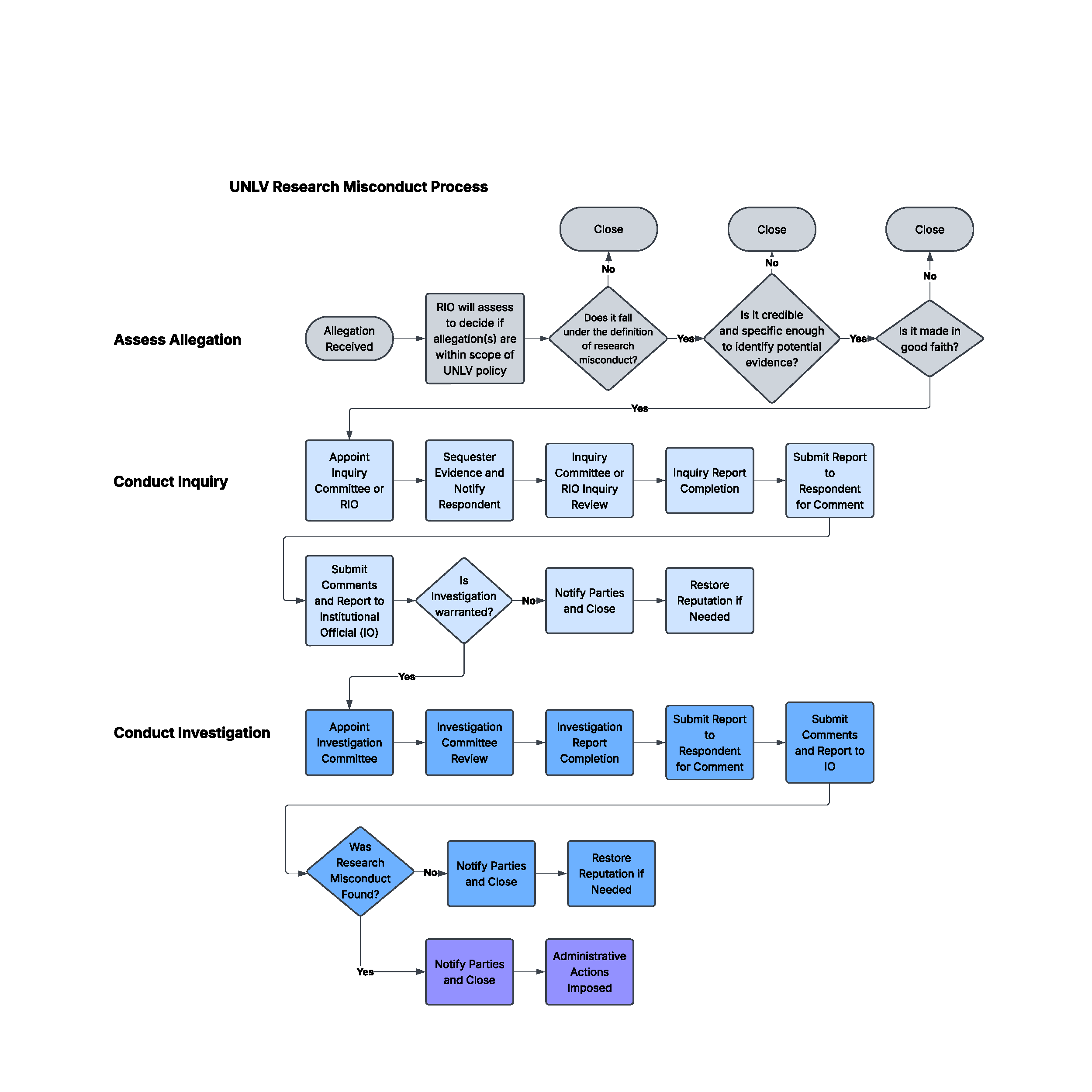
Select the image above to download the full-size image.
The research misconduct process consists of three stages: assessment of the allegation, inquiry, and, when warranted, investigation.
When an allegation is received, the Research Integrity Officer (RIO) assesses whether it falls within the scope of UNLV policy. The RIO determines whether the allegation meets the definition of research misconduct, is credible and specific enough to identify potential evidence, and was made in good faith. If the answer to any of these questions is no, the matter is closed. If all three conditions are met, the process proceeds to an inquiry.
During the inquiry stage, an inquiry committee is appointed, or the RIO conducts the inquiry. Relevant evidence is sequestered, and the respondent is notified. The inquiry committee or RIO reviews the matter and completes an inquiry report. The report is provided to the respondent for comment, after which the comments and report are submitted to the Institutional Official (IO).
The Institutional Official determines whether an investigation is warranted. If an investigation is not warranted, the parties are notified, the matter is closed, and the respondent’s reputation is restored if needed. If an investigation is warranted, an investigation committee is appointed.
During the investigation stage, the investigation committee reviews the matter and completes an investigation report. The report is provided to the respondent for comment, and the respondent’s comments and the report are submitted to the Institutional Official.
If the investigation does not result in a finding of research misconduct, the parties are notified, the matter is closed, and the respondent’s reputation is restored if needed. If research misconduct is found, the parties are notified, the matter is closed, and administrative actions are imposed.
Confidentiality
UNLV recognizes the importance of protecting the confidentiality of individuals involved in research misconduct proceedings. The identity of respondents, complainants, and witnesses are limited, to the extent possible and consistent with applicable law, to individuals who need to know the information to conduct a thorough and fair proceeding. Confidentiality requirements may also apply to research records, evidence, and information that could identify research participants or other individuals.
Because the circumstances of individual cases vary, confidentiality cannot always be guaranteed. Information may be disclosed when required by law, regulation, institutional policy, funding requirements, or when necessary to conduct the research misconduct proceeding.
Good Faith Reporting
UNLV encourages members of the research community to raise concerns about possible research misconduct in good faith. A good faith allegation is based on a reasonable belief, based on the information known at the time, that research misconduct may have occurred before reporting a concern.
Policies and Resources
- UNLV Research Misconduct Policy
- Rules and Procedures for Responding to Allegations of Research Misconduct
- Nevada System of Higher Education (NSHE) Code
- Compliance Guidance for Researchers
- Responsible Conduct of Research (RCR) Training
- Laboratory Safety Information – Office of Risk Management & Safety
- UNLV Quality Assurance/Quality Improvement
Reporting a Concern
Anyone who has a concern that research misconduct may have occurred is encouraged to report it. Reports may be made to:
- UNLV Research Integrity and Compliance Officer, Julie Bertoia, at julie.bertoia@unlv.edu or 702-895-5948
- EthicsPoint website or call EthicsPoint anonymously at 1-844-665-2938
- UNLV Office of Research Integrity email at ori@unlv.edu
Reports are treated as confidential to the extent permitted by law and university policy, consistent with a fair and thorough review of the matter. UNLV prohibits retaliation against any individual who, in good faith, reports a concern or participates in a research misconduct proceeding.