Art Exhibition: el Camino se Traza al Andar (the Path is Traced by Walking)
When
Campus Location
Office/Remote Location
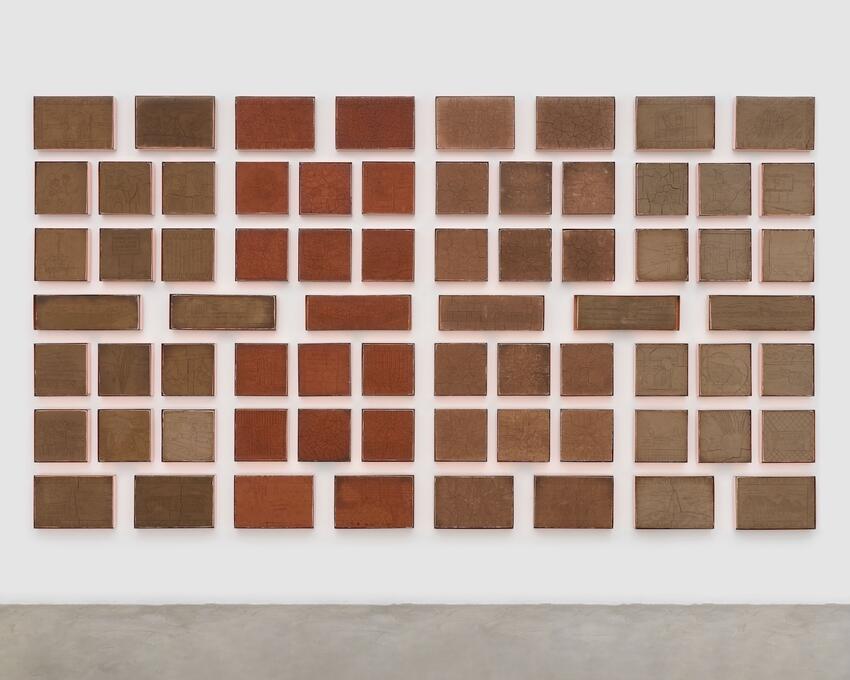
Jackie Amézquita, bajo el cięło sobre el mismo suelo, 2024, Soil sourced from the 1,951 mile border that connects the U.S and Mexico, corn masa, salt, cal (dehydrated lime), rain water, framed with copper. Image courtesy the artist and Charlie James Gallery.
Description
The Marjorie Barrick Museum of Art is proud to present el Camino se Traza al Andar (the Path is Traced by Walking), an exhibition of artworks by the Los Angeles-based interdisciplinary artist Jackie Amézquita.
Amézquita’s artistic practice is intended to spark reflections on collective mobility, adaptation, and endurance, all connected to the challenging journey of migration. Her work responds to the multiple implications of the word tierra, which in Spanish means land, earth, soil, homeland, and ground. Tierra is often accompanied by libertad, freedom, as in Tierra y Libertad!, a phrase that was part of the ideology of the Mexican Revolution. For Indigenous women in the artist’s country of birth, Guatemala, the first line of defense is the female body. Cuerpo-tierra (body-land) is the approach for communities that want to heal their cuerpos indignados (indignant bodies) that have been subject to repeated acts of violence.
“Hay que curarle el susto a la tierra” (we need to heal the Earth from its trauma), she says. She binds soil together with rainwater, rocks, copper, limestone, and corn, considering them conductors of ancestral knowledge and engaging them with respect. Limestone and corn are nutrients, copper is a healing metal, and rainwater helps to cleanse the soil. All of these elements are combined to create “earthen paintings” such as “entre Tejas y Chihuahua” and “entre California y Baja California,” as well as the monumental “bajo el cięło sobre el mismo suelo,” which mirrors the left-to-right, bottom-to-top layout of a traditional Mayan codex. Made with soil gathered along the length of the US–Mexico border, the works materially connect territories that have been politically divided yet geologically continuous for millennia.
She creates durational walking performances to trace the land and recover its memories. The performances represented in this exhibition range from a relatively short but significant walk across the Rose Kennedy Greenway in Boston at sunset, to an eight-day journey from Tijuana to Los Angeles, and a longer trek from the US to Guatemala that took almost a month. The hand-crafted bodysuits she wore during her longest performances operated as both shields and witnesses. Seen in this exhibition, after the journeys have been completed, they are torn and stained, clearly changed by her actions. Functioning simultaneously as sculpture, drawing, and ritual garments, they position walking as an act of inscription.
Soil gathered during “Huellas que Germinan (Foot Prints That Sprout),” her journey from Tijuana to Los Angeles, is mixed with masa and transformed into two text works, “Sortilegio N.1 (Spell 1)” and "Sortilegio N.2 (Spell 2)." The “Spells” are repositories for her feelings, her physical experiences, and her relationship with the land.
Amézquita’s artistic practice stands in defense of cuerpo-tierra as a collective act to sustain communal life, aligning her with the resistance of Indigenous women who defend the land. In el Camino se Traza al Andar (the Path is Traced by Walking), she gives us a map that returns the gaze to la tierra, an archive of the time and space of many lives.
The exhibition will be on view in the West Gallery of the Marjorie Barrick Museum of Art from February 20–June 13, 2026. The Museum is open from Tuesday–Saturday, 10 a.m.–5 p.m. It is closed on state and federal holidays. Entry is free. The text in this announcement has been adapted from an essay by Daniela Lieja Quintanar.
This project was supported, in part, by a Foundation for Contemporary Arts Emergency Grant.
About Jackie Amézquita
Jackie Amézquita is a Los Angeles-based interdisciplinary artist whose work explores the relationships between land, memory, and identity across genealogies. Her practice is channeled through the fuse of biomaterials such as earth, masa, charcoal, and rain, treating them as active carriers of ancestral knowledge. Through installations, performances, and sculptures, Amézquita engages the ecological and spiritual dimensions of place, emphasizing impermanence, transformation, and interdependence among human and more-than-human worlds.Amézquita received her M.F.A. from the University of California, Los Angeles in 2022 and her B.F.A. from Art Center College of Design, Pasadena, CA, in 2018. She has exhibited with The Hammer Museum, LACE (Los Angeles Contemporary Exhibitions) CA, LAND (Los Angeles Nomadic Division) CA, 18th St Art Center CA, The Armory Center of the Arts CA, Vincent Price Art Museum CA, The Annenberg Space for Photography CA, Human Resources Los Angeles CA, MAD (Museum of Art and Design) NY. Amézquita is the recipient of the Mohn Public Recognition Award (2023), Mohn Land Award (2023), Andy Warhol Foundation for the Arts Los Angeles Art Fund (2022), and National Performance Network Fund (2022). Her work is in the permanent collections of the Hammer Museum Los Angeles, CA and Denver Art Museum, Denver, CO. She has been featured in Art in America, Cultured, Flaunt, whitewall, Los Angeles Times, ARTnews, The Art Newspaper, LA. Weekly, hyperallergic, and Walker Art Center magazine.
Admission Information
Admission is free. All are welcome.