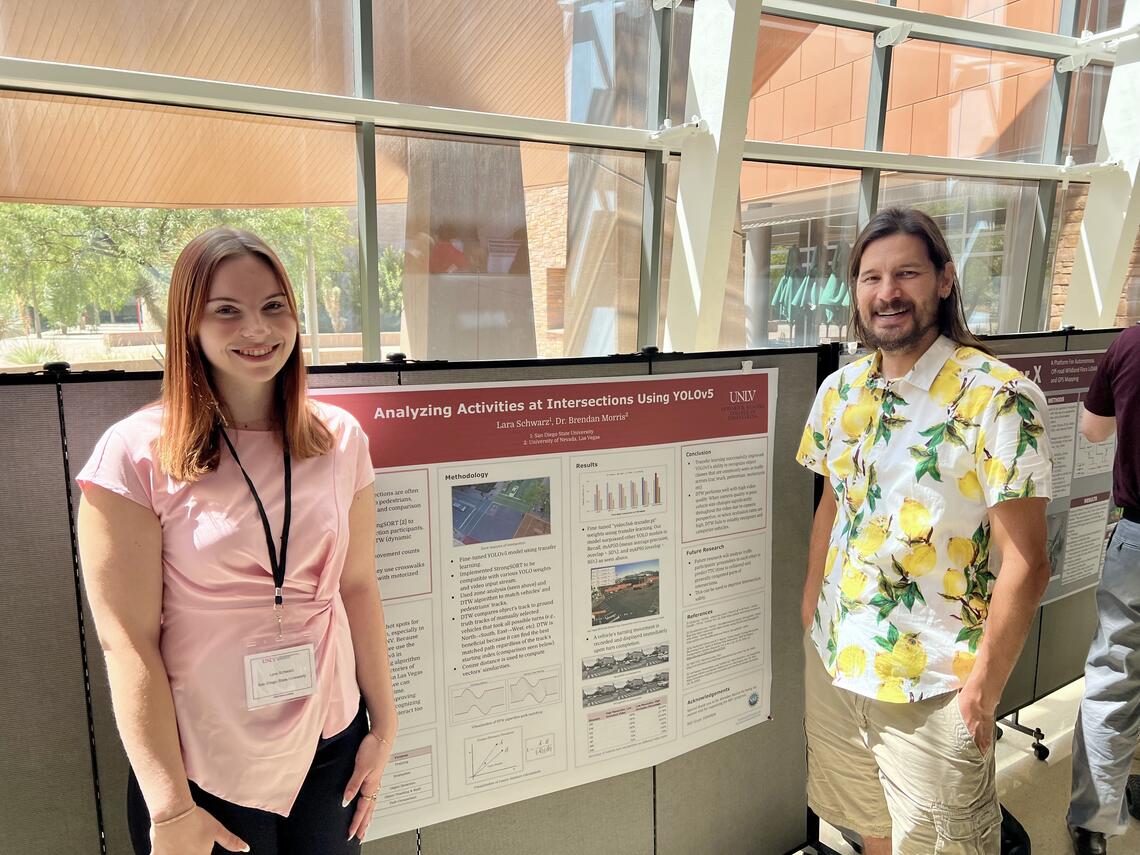
Lara Schwarz (left), a rising junior at San Diego State University, was one of 11 students from across the U.S. and Puerto Rico to attend the NSF-funded Research Experiences for Undergraduates (REU) Smart Cities program hosted at the UNLV College of Engineering. Brendan Morris, professor of electrical and computer engineering, served as her mentor.
Mario Hernandez, a REU participant, presents his final research findings to his mentor, Ebrahim Saberinia, a UNLV professor of electrical and computer engineering.
Lara Schwarz was searching for a summer job that would take her beyond the confines of her usual camp counselor gig and put her on the right track to reach her career goals.
The computer science major at San Diego State University landed at the UNLV College of Engineering for an intensive, nine-week research experience that challenged undergraduates from across the country to study ways to make cities smarter.
“I did research last summer as well, but it was remote and a lot more unofficial than this,” Schwarz said. “I had a really good experience doing that, so I wanted to do a more intense experience to figure out if research is right for me.”
Schwarz, a rising junior at SDSU with plans to attend graduate school, was one of 11 students from across the U.S. and Puerto Rico to participate in the NSF-funded Research Experiences for Undergraduates (REU) Smart Cities program at UNLV.
Now in its fifth year, the program at the College of Engineering has introduced 50 students from UNLV and across the nation to the rigors of research in an effort to encourage advanced study in intelligent transportation systems, automated vehicles, and vehicle-to-everything communication.
“Our goal is to point students toward research problems that are not only interesting but also critical to society, and work alongside UNLV mentors to learn what it takes to become a researcher,” said Brendan Morris, a professor of electrical and computer engineering at UNLV and principal investigator on the grant.
Scwharz worked with Morris, her mentor, to study ways to use computer vision to track pedestrians and vehicles as they move through an intersection. The data can help inform traffic engineers of problems at intersections — like an overly congested crosswalk — and predict time-to-collision.
"Traffic operators are focused on catching congestion and accidents early," Morris explained. "When we spot problems quickly, we can get the right people and resources there faster. That cuts down on delays significantly, and it's safer too because it gives emergency crews those extra crucial minutes they need.”
The goal of the project was to further the development of a traffic prediction platform which combines traffic sensors with machine learning algorithms for prediction up to one hour into the future with a web-based visualization dashboard for traffic operator use.
“I couldn’t have done it without Dr. Morris,” Schwarz said. “He is an expert on computer vision, so for everything I did, he had a lot of insight. My topic is also something that’s contemporary and relevant to the research industry right now.”
Following the experience, Schwarz is already considering her next steps, including applying to competitive internship programs.
“I’ve already asked him for a letter of recommendation,” Schwarz said.