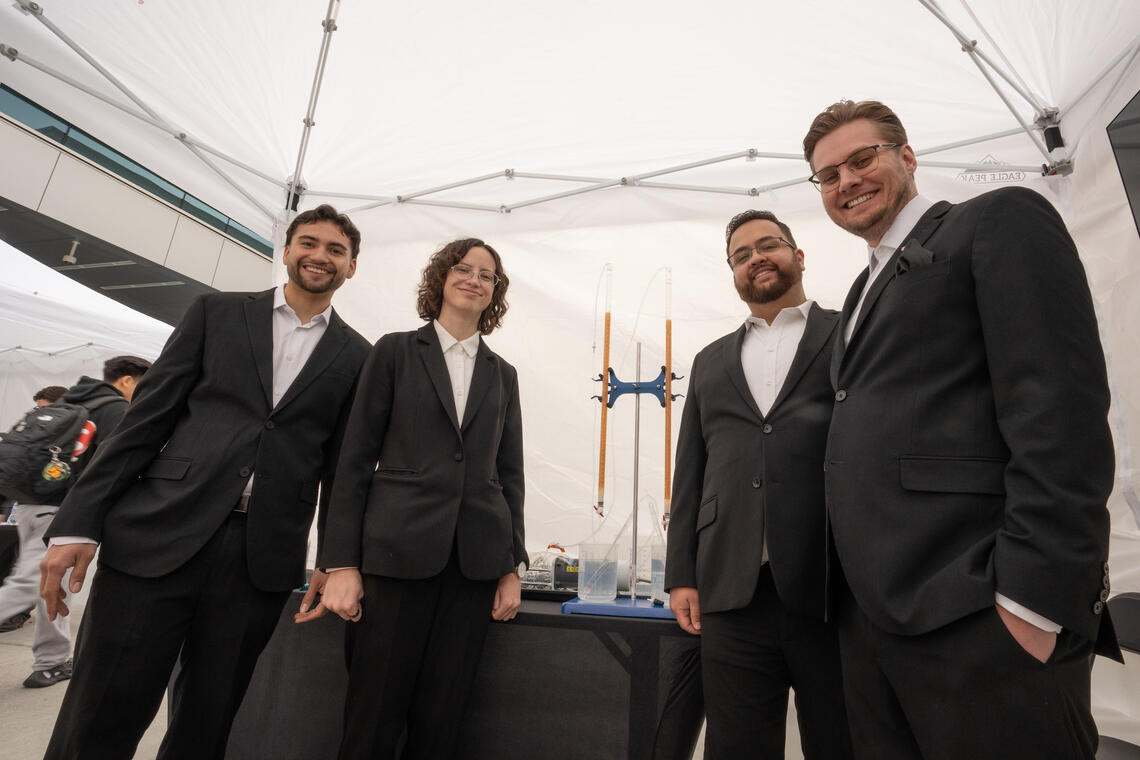
(From left) Civil engineering majors Adrian Montenegro, Alyssa Surette, Daniel Nevarez, and Elias Black, proposed a plan to treat perched groundwater as a solution to cool data centers at the Fall 2025 Fred and Harriet Cox Senior Design Competition. The team presented a fully working model of the water treatment process they proposed. (Photo courtesy of Radioactive Productions)
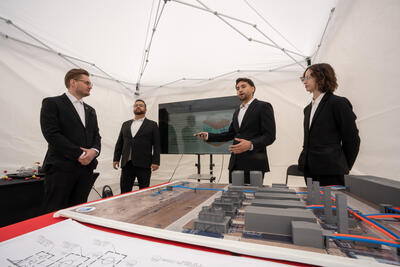
Team Waste to Watts pitches their idea to a panel of industry judges at the 25th anniversary of UNLV's Senior Design competition on Tuesday, Dec. 2. (Photo courtesy of Radioactive Productions)
Civil engineering students pitch sustainable data center cooling solution at Engineering’s biannual Senior Design Competition.
Save the drinking water for people, not machines.
That’s the pitch one UNLV College of Engineering Senior Design team delivered to a panel of industry judges during the Fall 2025 competition.
Team Waste to Watts — competing among 42 student teams in UNLV’s biannual Senior Design competition — understands how important your generative AI prompt is. But the data that tools like ChatGPT, Claude, and others draw upon to answer prompts and create content seemingly out of thin air needs something to cool it down.
“The water and energy needed to sustain the exponential growth of AI data centers is a national issue that is quietly going on underneath us,” said civil engineering major Adrian Montenegro, adding that by 2028 the expected water usage for data centers is projected to reach 64 billion liters annually.
“To give you an amount, that equates to a town of about 500,000 people,” Montenegro said.
Most data centers across the country currently rely on municipal potable — or drinking — water for cooling, putting added stress on local supplies. And in water stressed regions like the Desert Southwest the problem is even more acute.
Waste to Watts drilled down to a water source with untapped potential just below the city of Henderson’s surface that, up until now, has been seen as “waste.” The proposal, developed over months by Montenegro and teammates Alyssa Surette, Daniel Nevarez, and Elias Black, centered around Google’s data center in Henderson.
“Our project tackles Henderson’s hidden water challenge by turning unused perched groundwater into a resource for data center cooling,” said Surette, a civil engineering major. “By reusing what’s already beneath our feet, we cut strain on drinking water supplies and create a sustainable path for the city’s growing tech infrastructure.”
On construction sites, the water is typically viewed as a "nuisance,” Surette said, because the water is dirty, containing high amounts of total dissolved solids like sulfates, calcium, magnesium, and chloride.
“The corrosion interferes with the infrastructure, so they de-water it and pump it out and basically remove it to the storm drain,” Surette said.
The team tested ion exchange and reverse osmosis as two possible technologies to treat the magnesium, sodium, calcium, and sulfates to an acceptable level, ultimately settling on reverse osmosis. The water treatment could happen on site, according to the team’s proposal, and offset potable water usage by 23%.
“By acting now, Henderson can lead in sustainable infrastructure and prepare for the scale of growth that’s already on the horizon,” Montenegro said.
The team presented their official pitch, not once, but twice on Dec. 2. A VIP group was the first to hear it, with the panel of industry judges right behind them.
“We didn't get a lot of feedback in the moment, but at the end they did ask us some questions, and thankfully we were able to answer all of them,” Surette said. “They seemed interested.”
So, too, did members of the public.
The competition, now in its 25th year, challenges students to build commercially viable prototypes and innovate solutions to engineering and computer science problems.
The morning features teams presenting their innovations to judges, with the afternoon transitioning into a public showcase of all 42 projects and teams fielding questions from community members.
By the end, team Waste to Watts was pretty confident they won at least one prize. They’ll find out on Monday, Dec. 15 when the competing teams hear the results at the biannual awards dinner.
Prizes are handed out by discipline, and also via special categories including commercial potential, innovation, sustainability, popular choice, and, of course, the grand prize.
“It’s been really fun having to use those critical thinking skills and trying to figure out how we can help the world in a positive way, while also making things feasible and cost efficient,” Surette said.