I hate summer camp.
That was a camper’s first line during a poetry exercise on the first day of the inaugural Literacy with the Arts (LwtA) summer camp. The student had arrived determined not to enjoy the experience, and he was honest about it. Instead of pushing back, the instructors helped him transform his feelings into a haiku. And by the end of the three-day program, he had made friends, eagerly participated in different art activities, and was sad that the camp was over.
“That singular transformation captured the camp’s essence,” said Chad Scott, co-director and artist-in-residence at the Zeiter Literacy Development Center.
Sponsored by the center and UNLV Early Outreach, the camp welcomed 25 participants in grades 2-5 and provided them with hands-on literacy and arts instruction.
The camp was developed by Chad and fellow Literacy faculty members Chyllis Scott and Danielle Rylak, who collaborated with local artists and poets. Instructional and operational support was also provided by Emerita faculty member Claire Tredwell, two literacy doctoral students, and one undergraduate student.
From Conversations to Camp
The idea for the summer camp grew out of a series of conversations. The Early Outreach program sought meaningful ways to engage more elementary-aged students through summer camp opportunities, while the college faculty members were exploring ways to extend literacy and art activities beyond traditional classroom approaches.
According to Chyllis, hands-on experiences with literacy and arts integration support students’ information retention and engagement.
Beyond Reading
Unlike traditional literacy camps that focus solely on reading and writing skills, this camp challenged young learners to view books as a gateway to creativity.
With assistance from Amanda Melilli, head of the Teachers Development Resources Library, the team curated an extensive collection of books and developed lessons centered on artists whose work connects poetry and visual art. Titles such as Beautiful Oops by Barney Saltzberg reinforce themes of self-expression and encourage the children to see mistakes as opportunities to create.
By combining literacy and art, the campers discovered new ways to communicate, express themselves, and connect.
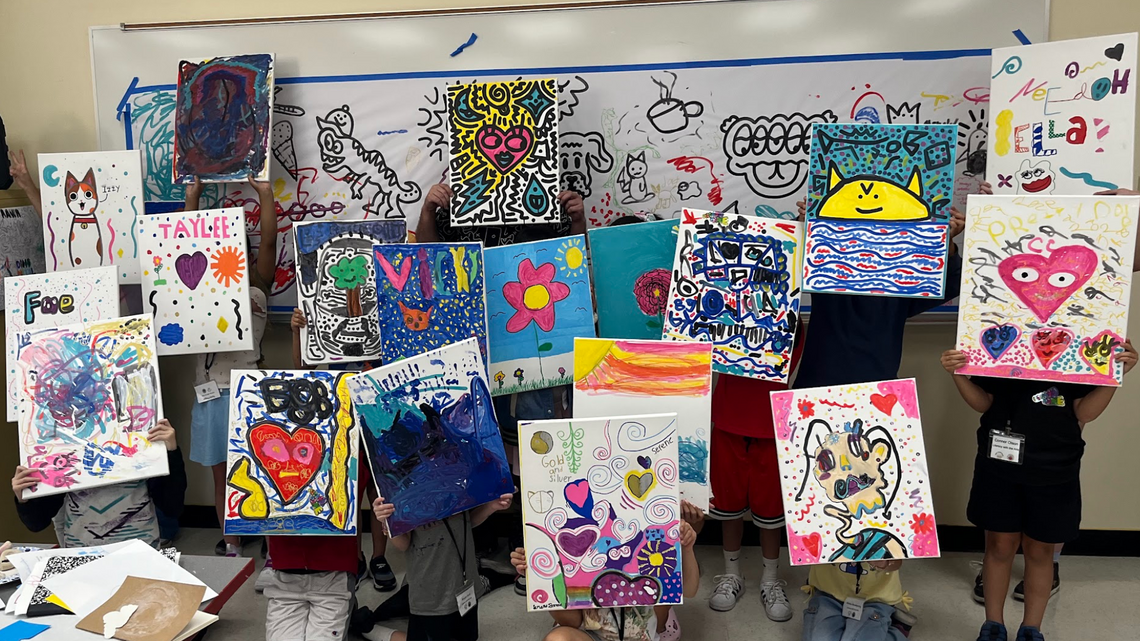
On the first day, the campers read about the life and works of renowned artist Jean-Michel Basquiat. Then, they translated their learning into clay dinosaur sculptures, poems, and journal entries under the guidance of local poet Heather Lang-Cassera.
The next day, they learned about environmental awareness and public art through readings and activities that engaged with the work of artist Keith Haring, before participating in a painting class led by muralist Pretty Done.
On the final day, the campers explored the life of artist Yayoi Kusama with a read-aloud. They also participated in an acrylic pour painting lesson led by Vogue Robinson and Brittni the Creative, who demonstrated techniques before the campers transformed their artwork into original writing.
For the artists, the partnership was rewarding and inspiring.
"The experience reinforced my belief that curiosity, play, and imagination can spark learning, growth, and connection at every age," Heather Lang-Cassera said.
Student Collaboration
Doctoral students Cherish Olson and Kelly Byrd, and undergraduate student Allison Gonzalez, worked closely with faculty members to plan, teach, and support learning activities.
Their participation not only equips them for their future educational careers but also lays the groundwork for co-authorship opportunities as the team hopes to contribute to the growing body of research and scholarship in arts integration, including a future graduate certificate program in arts integration.
Until Next Summer
For the team, watching the campers grow more confident and engaged was the highlight of the camp. Following a successful first iteration, they plan to establish it as a summer tradition.
Future camps may extend beyond three days and include a final showcase where parents can view the artwork and writing their children created throughout the week. The team is also considering a broader STEAM model that integrates the arts with science, technology, engineering, and mathematics, and expanding opportunities for more UNLV students to be involved in the summer camp experience.
Until then, they hope that they have helped the children see themselves not just as learners, but as storytellers, artists, and creators.
By: Sakinah Musa