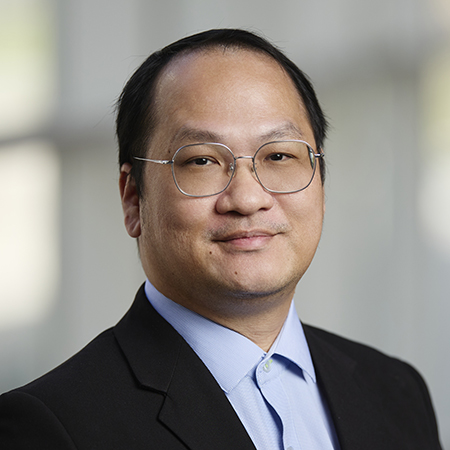
Mai-Khanh (Mike) Nguyen, Ph.D.
Assistant Professor
Biography
Mai-Khanh (Mike) Nguyen, Ph.D. is an assistant professor in the Department of Electrical and Computer Engineering at UNLV. His research focuses on RF, millimeter-wave (mm-wave), and terahertz (THz) integrated circuits and systems, analog and mixed-signal IC design, antenna–IC co-design, heterogeneous integration, chip-to-chip communication, hardware security, and AI-enabled sensing systems.
Before joining UNLV, Nguyen was an assistant professor at San José State University and previously held research and faculty positions at the University of Tokyo. He also worked as a senior staff manager at Marvell Technology, where he led analog and mixed-signal IC design projects using advanced semiconductor technologies.
His research spans the complete development of high-frequency integrated systems, including CMOS RF/mm-wave circuits, on-chip and in-package antennas, sub-THz sensing, heterogeneous chiplet interconnects, and high-frequency measurement techniques. He has tapeout experience across multiple CMOS technologies (180 nm to 28 nm), has authored more than 60 peer-reviewed journal and conference publications, and holds U.S., Japanese, and Vietnamese patents in RF, antenna, and IoT sensing technologies.
Nguyen is a senior member of IEEE and serves on the executive committee of the IEEE International Conference on Integrated Circuits, Design, and Technology (ICICDT). He previously served as tutorial chair of IEEE ICICDT 2026, conference chair of IEEE ICICDT 2023, session chair for IEEE CAMA (2022–2024), and IEEE co-chair of the 2023 ICICDT in Tokyo, Japan.
He is an active reviewer for leading international journals, including IEEE Transactions on Microwave Theory and Techniques, IEEE Transactions on Instrumentation and Measurement, IEEE Sensors Journal, and other IEEE and Springer journals.
His research has been supported by competitive funding from government agencies and industry, and his current work aims to advance next-generation integrated sensing and communication technologies for food safety, biomedical sensing, smart agriculture, and future chiplet-based computing systems. He welcomes collaborations with academia and industry, as well as graduate students interested in RFIC, analog/mixed-signal IC design, mm-wave/THz systems, antennas, and AI-enabled sensing.