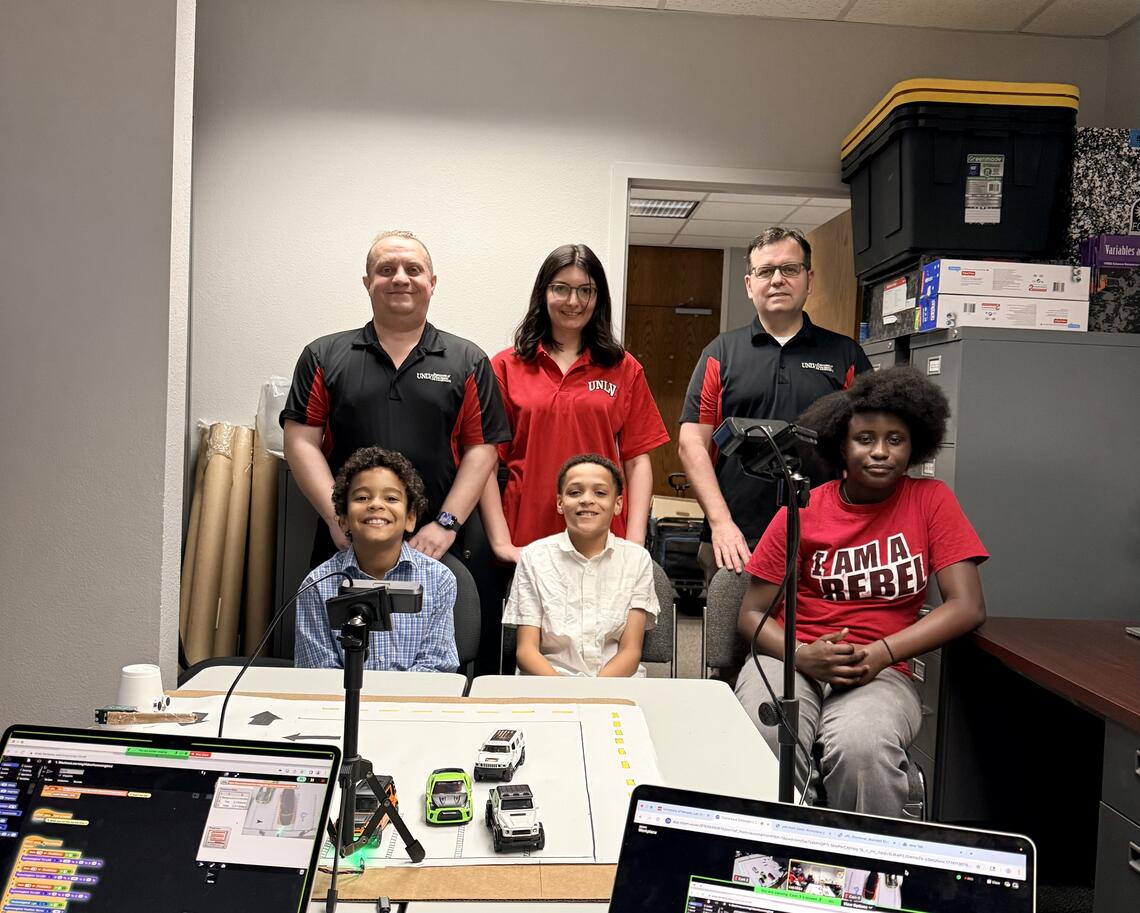
A team of elementary school students who participated in the UNLV Saturday STEM Program last fall won the statewide Elementary Category Track II (Technical/Implementation) division in the Presidential AI Challenge.
This achievement highlights the impact of early exposure to STEM and AI education. Structured mentorship and hands-on learning empowers young students to innovate and succeed. The Saturday STEM Program, administered by the Center for Mathematics, Science, and Engineering Education (CMSEE), continues to foster the next generation of scientists, engineers, and problem-solvers through engaging, real-world learning experiences.
The Winning Project
Elementary school students Vasili Moseley, Tasheni Kamanga, and Joshua Scott developed a smart parking system using AI and sensor-based technologies to detect incorrect parking and improve overall parking efficiency.
The project originated in a six-week “Integrating Engineering, Robotics, and AI for STEM Learning” class, which focused on emerging technologies through hands-on, project-based experiences. Students learned computer science concepts and artificial intelligence strategies through hands-on experience with sensors, microcontrollers, and LEDs. Following the course, students were invited to a four-week workshop offering structured mentorship and support to develop their competition projects.
Their project was selected from more than 2,500 submissions nationwide, earning recognition as one of only 328 state-level winners.The team has since advanced to the regional competition, where they presented to a panel of judges, competing alongside other state champions. Results from the next stage of the competition are pending.
Learning behind the Learning
The course, taught by CMSEE center director Hasan Deniz, and students Dilara Kara-Zorluoglu, and Metehan Zorluoglu, was developed through a collaborative National Science Foundation grant, "Cultivating Artificial Intelligence Literacy through Linguistically Inclusive Integrated Elementary Curriculum via Educational Robotics." Drniz is the primary investigator and Erdogan Kaya (University of Texas at Arlington), Ezgi Yesilyurt (Utah State University), and Refika Turgut (University of South Carolina Upstate) were co-PIs.