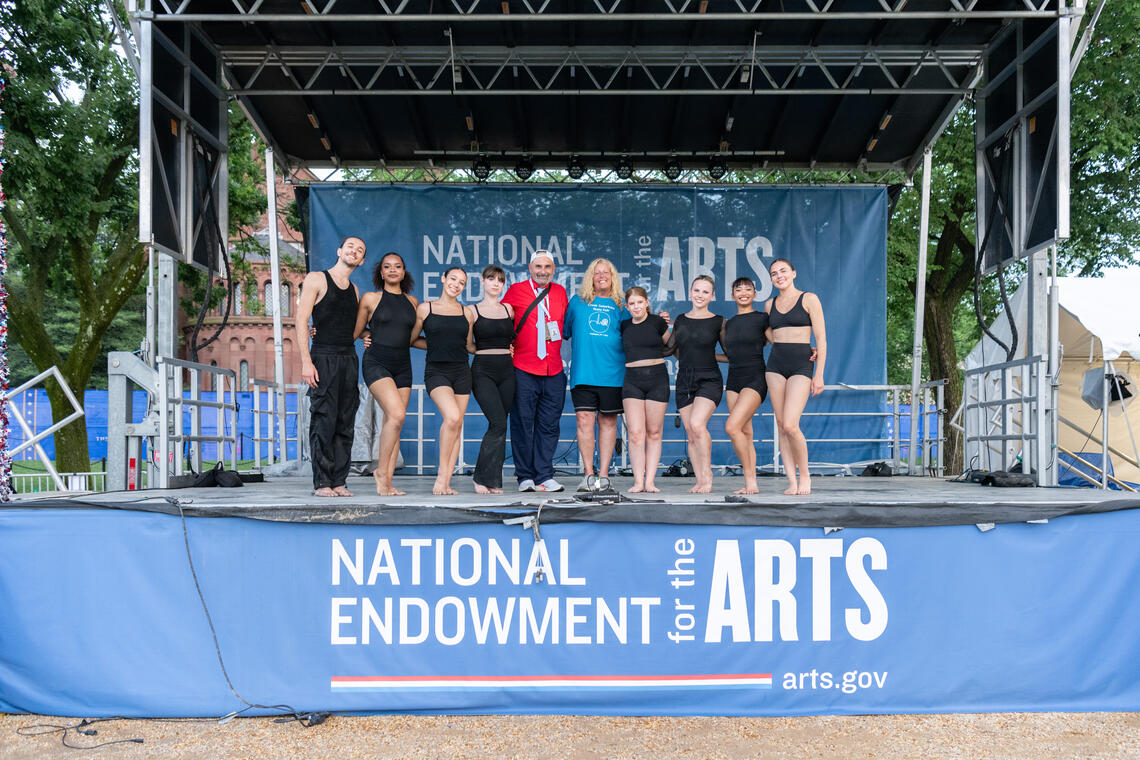
Photo: Mike Morgan
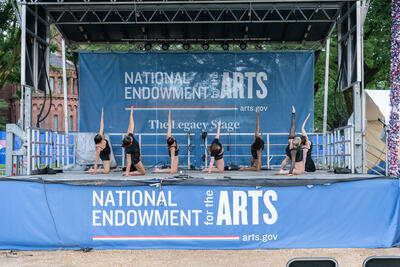
UNLV Dance performed on the National Mall in Washington, D.C., on June 25 as part of the National Endowment for the Arts Legacy Stage at the Great American State Fair, celebrating America’s 250th anniversary.
Below are remarks from Louis Kavouras, chair of UNLV Dance.
Dear friends,
We’re back from Washington, D.C.
Travel changes us twice—once when we arrive, and again when we sit quietly enough to reflect on where we have been. As always, forgive the length. Writing has always been how I make sense of experiences, and this one deserves a few words.
First and foremost, our UNLV Dance majors were extraordinary.
They danced through intense heat, rain showers, muddy stages, and all the unpredictability that comes with performing outdoors. They adapted with grace, supported one another, remained joyful, and represented UNLV Dance with remarkable professionalism.
We did what we always do.
We showed up with dance, imagination, and generosity.
We moved, and in doing so, we moved people.
We were honored to be invited by Mary Anne Carter and the National Endowment for the Arts to perform on the Legacy Stage in organization with the Meridian International Center’s Arts and Sports Diplomacy program as part of America’s 250th celebration.
Although the stage measured only twenty-four by eighteen feet, the experience felt immeasurable. Sometimes the smallest stages ask the biggest questions of us. Our students answered every one with artistry, resilience, and heart.
The National Endowment for the Arts assembled an inspiring community of artists—African stilt walkers, Native American hoop dancers, storytellers, cirque performers, singers, actors, musicians, and dancers from across the country. It was a beautiful reminder that the arts are strongest when many voices share the same stage.
Our students were treated with extraordinary generosity. Their travel, lodging, transportation, and performance stipends were fully supported, allowing many of them to experience Washington, D.C., for the very first time—not simply as visitors, but as artists representing their university and art form on a national stage.
I encouraged them to think of this not simply as a paycheck, but as an investment in their education and in their future. It was also a reminder that their work and artistry matters.
Every performance found its audience.
Children danced in front of the stage.
Families gathered on the lawn.
People heard the music from across the fairgrounds and wandered over to discover dance.
Many stayed afterward simply to say thank you.
Several audience members told us it was among the most beautiful performances they had experienced. One family shared that their daughters dance and that UNLV would now be on their list of universities to visit. Another audience member, with tears in her eyes, quietly asked, “Where can I see them perform again?”
Those moments remind me why we do what we do.
For many people, live concert dance is a rare experience.
For a few precious minutes, our students offered beauty, possibility, and joy.
Watching UNLV Dance perform in the shadow of the Washington Monument beneath a banner reading National Endowment for the Arts was a moment I will not soon forget. Behind us stood monuments built from marble and memory. In front of us stood eight young artists reminding us that culture is not only preserved in museums—it is created every time someone steps onto a stage.
It was equally meaningful to return the work of Erick Hawkins to Washington.
His Parson Weems and the Cherry Tree (1976) and Classic Kite Tails (1972) remain remarkable landmarks of American modern dance. At Erick Hawkins West, housed at UNLV, we are not simply preserving choreography—we are preserving a way of thinking about movement, imagination, and the American spirit.
Watching our students carry those dances into the future was one of the quiet joys of the week.
Outside of our performances, the students embraced Washington with equal enthusiasm.
They explored the Smithsonian museums, visited the National Gallery of Art, the National Museum of African American History and Culture, the National Museum of the American Indian, the National Museum of African Art, the National Museum of Asian Art, the National Museum of Natural History, the U.S. Botanic Garden, and the Holocaust Memorial Museum. Together we toured the Capitol and stood beneath its magnificent dome.
Every museum became another classroom.
Every gallery another conversation.
Every artifact another reminder that history is less about the past than it is about what we choose to carry forward.
One experience deserves special mention.
Earlier this summer, while Dance Design Specialist Michele Anderson and I were organizing the Erick Hawkins Collection at UNLV, I opened a box labeled Xylophone.
There was no xylophone.
Instead, it contained nearly forty pounds of Lucia Dlugoszewski’s childhood writings—poetry, musical compositions, photographs, scrapbooks, awards, and even letters from the White House acknowledging birthday poems she had written as a child to President Franklin Roosevelt.
Naturally, I packed all forty pounds into a suitcase and brought them to Washington.
It was deeply meaningful for our students to watch UNLV contribute to preserving American dance history by delivering these materials to the Library of Congress. In many ways, they realized they were becoming part of that history themselves.
Every student received a Library of Congress Researcher Card, officially joining the community of scholars who study and preserve our artistic heritage.
Libby Smigel, Head of the Dance Division at the Library of Congress, welcomed us for a private archival session unlike anything most young dancers ever experience. Together we explored materials from Erick Hawkins, Martha Graham, Hanya Holm, Denishawn, and Lucia Dlugoszewski.
Several students returned the following day on their own, requested archival boxes, and spent hours reading correspondence between Erick Hawkins, Martha Graham, and Lucia Dlugoszewski.
That made me incredibly proud.
They weren’t simply studying dance history.
They were discovering how history is made—one letter, one sketch, one choreography notebook, one idea at a time.
They learned what every researcher eventually discovers: archives are not dusty boxes filled with old papers. They are living conversations. Every handwritten note, every correction in the margin, every photograph offers another doorway into the mind of an artist. They invite us not merely to remember history, but to understand it more deeply.
Throughout the week, our artistic statement remained beautifully simple.
AMERICA IS…
A nation is not defined by a single story, but by many voices, many dreams, and many journeys. Through dance, we celebrate the qualities that continue to shape the American spirit: Joy, Possibility, Trying, Connection, Drive, Perseverance, and Flight.
That message resonated deeply.
Again and again, people thanked us for reminding them that art possesses a remarkable ability to bring people together.
Professionally, the trip was an enormous success.
The National Endowment for the Arts praised both our performances and our professionalism.
The NEA and Meridian International Center expressed interest in future collaborations, including the possibility of representing the United States through future international cultural diplomacy initiatives even included the possibility of participating as part of the American delegation at the next World Expo in Serbia.
Time, as always, will decide which conversations become the next chapter.
We were also fortunate to have our performances beautifully documented by Washington photographer Mike Morgan, who generously made his photographs available for university and departmental use.
Most of all, I came home grateful.
Grateful for students who embraced every opportunity.
Grateful for colleagues whose teaching prepared them so well.
Grateful that dance continues to create conversations where words often cannot.
What our students carried to Washington was never just choreography.
They carried the values of the UNLV Department of Dance: artistry, curiosity, discipline, generosity, courage, and excellence.
Most importantly, they carried the belief that art still matters—that a dance can open a conversation, preserve a history, inspire a child, and remind complete strangers that beauty still belongs in the world.
As a small boy, I collected the commemorative bicentennial quarters and refused to spend them. I am reminded that my collected coins bore those three Latin Words on them "E Pluribus Unum”……..out of many comes one. It takes all of us collectively together to make this America. Maybe a philosophical truth that many need to learn today.
For one remarkable week, UNLV Dance became ambassadors for our department, our university, and our art for the celebration of our countries 250th Anniversary.
I could not be more proud.
So very proud.
—Louis Kavouras, Distinguished Professor and Chair, UNLV Department of Dance