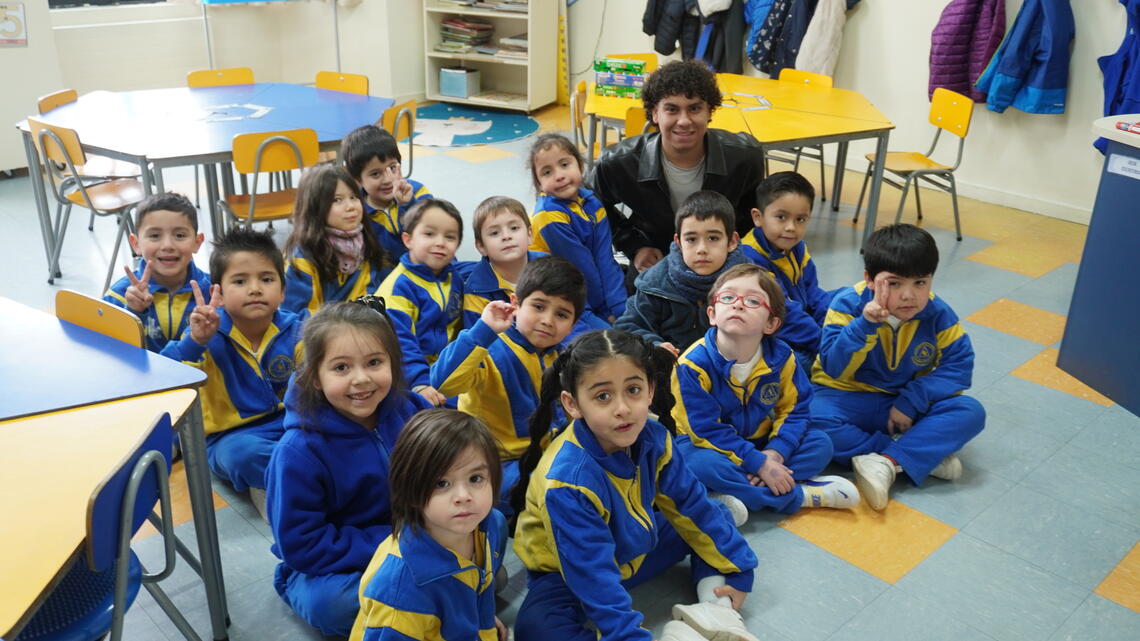
Ionel Vazquez-Ramos thought he understood bilingual education. As a future teacher and a fluent Spanish speaker, he knew the importance of teaching in more than one language. But after spending two weeks co-teaching in a Chilean classroom, he discovered that bilingual education is about far more than language. It’s about understanding culture, building relationships, and helping every student feel seen.
That realization became the biggest takeaway for Ionel as he participated in the college’s Teach in Chile program, an immersive international experience that pairs future educators with Chilean teachers to learn from each other.
A Vision for Bilingual Education
Currently an instructional assistant at his former high school, Southeast Career and Technical Academy, Ionel has long dreamed of creating a bilingual inclusion program of his own. When he learned about the opportunity to teach in Chile, he immediately saw a chance to better understand what bilingual education can look like in a culture where Spanish is the primary language.
“It’s one thing hearing about the bilingual classes here, but it’s another thing actually living it in a whole different country that is native to that language,” Ionel said. “A bilingual classroom should really be adapted to both cultures that you’re trying to portray.”
Learning Side by Side
During his time in Chile, Ionel co-taught alongside a Chilean educator in a kindergarten classroom, observing lessons, sharing teaching strategies, and leading activities with students.
“From the first day, there were nonstop questions about how my life was here, how the classroom worked here, and we kind of just started to bounce ideas back and forth,” he said. “It was honestly a very welcoming, loving, and caring community.”
The collaboration became a true exchange of ideas. Ionel shared lesson plans and activities from his classroom in Las Vegas while his mentor teacher introduced him to Chilean teaching practices and classroom routines.
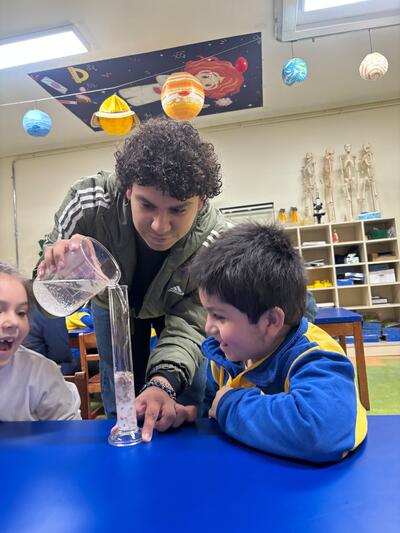
During the first week, Ionel focused on observing how students learned and how teachers built relationships with them. By the second week, he began leading lessons of his own, including a science activity inspired by an experiment he had done back home.
“[My mentor teacher] was always willing to teach me how they did their stuff, their attention grabbers,” Ionel said. “I learned a lot from her and she learned a lot from me.”
Lessons Beyond the Lesson Plan
Rather than focusing solely on instructional strategies, Ionel found himself paying close attention to the way his mentor teacher connected with students. He admired her ability to make learning engaging through storytelling, creativity, and play.
“The energy she has when reading a story — even I had to catch myself because I was so into it.The voice changes, the tones, the faces, the surprises… It captivated everyone.”
Watching his mentor teacher interact with students also prompted Ionel to reflect on his own classroom presence.
“I see myself as a very strict educator,” he said. “But she showed me that sometimes you just have to relax and enjoy the small moments, the smiles, and the fun.”
Ionel also noticed cultural differences in how students expressed connection and care. In Chile, he saw students frequently show affection through hugs, physical closeness, and personal interactions — something that helped him reflect on the ways classrooms can create a sense of belonging.”
“They want to feel seen, they want to feel heard,” he said. “That’s how they show love.”
Bringing Chile Home
Beyond the classroom, Ionel immersed himself in Chilean culture, exploring local communities, spending time with his host family, and learning about daily life. The experience reinforced for him that teaching requires a lifelong curiosity.
“It changed my mindset that you should never stop learning, and that as an educator, you’ll never stop growing,” he said.
The experience also reinforced his decision to make education his career. Before traveling to Chile, he expected to focus mostly on learning from another teacher. Instead, he found himself building meaningful relationships with students.
“I needed this experience to refresh my mind on my reason why I want to be an educator," he said. “Those little moments are what matters most.”
Looking ahead, Ionel hopes to bring pieces of Chile back to his future classroom — from teaching strategies and curriculum ideas to stories and cultural traditions.
For Ionel, teaching in Chile was more than an international experience. It was a reminder that great teaching is built through connection, collaboration, and a willingness to learn from others.
The UNLV Teach in Chile program is offered every summer.