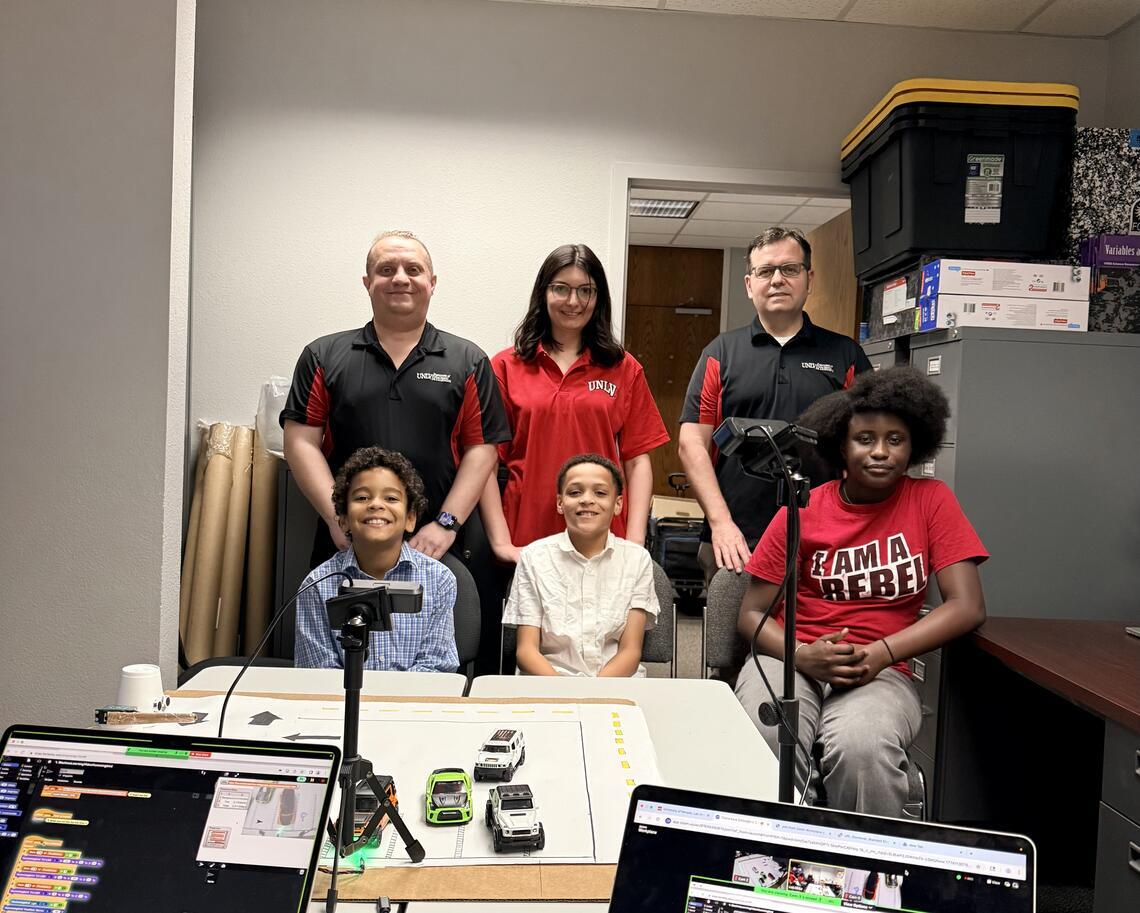
Dilara Kara-Zorluoglu believes the best way for the next generation to learn about emerging technology is to use it. As AI worms its way into our lives, those who understand it will have more opportunities to influence its effectiveness. Through hands-on learning in the Saturday STEM program, her students are introduced to how AI can be a powerful tool, while learning to question its limitations.
“Students should not only be users of this technology,” she said. “They should be critical thinkers who design technologies that meet their community’s needs.”
Introducing young learners to STEM subjects and tools is about more than preparing students for technical careers. AI already shapes the videos they see, apps they use and the information they see every day. When students understand how it works, they become more thoughtful participants in their AI-infused world.
From Childhood Curiosity to Research
Long before AI was a part of everyday conversation, the middle school-aged Dilara imagined a model that could make learning science easier. Now, as a fourth-year curriculum and instruction Ph.D. candidate, she is studying how computer science and artificial intelligence can be integrated into science education.
With support from a National Science Foundation research grant, she finally has a chance to turn a childhood idea into real research. As a graduate assistant with the Center for Mathematics, Science and Engineering Education (CMSEE), she teaches in the center’s Saturday STEM program helping elementary school students build the kinds of projects she once imagined.
The connections between research and practice she facilitates are increasingly important as AI becomes more pervasive. Through trial and error Dilara gives students the space to learn. Even the best built AI systems cannot replace human knowledge, experience, or judgment.
Build, Test, Question, Repeat
This reality came to life during a recent Saturday STEM project focused on a surprisingly common problem: cars taking up more than one parking space. Using images of correctly and incorrectly parked cars, students trained an AI-assisted system to detect a vehicle outside the lines and warn its driver.
“At one point in the project, they realized their model wasn’t working properly because they didn’t have enough images for that specific class,” Dilara explained. Rather than treating the mistake as a dead end, they worked through the problem, adding more images before testing the system again.
The smart parking project was later submitted for the Presidential AI Challenge and selected as one of 328 state-level winners from more than 2,500 submissions nationwide.
For Dilara, the project demonstrated the value of letting students learn by doing. Instead of simply being told how AI works, students saw that AI doesn’t think independently or produce perfect answers. Its predictions depend on the data that people feed it and the choices humans make while building and refining it.
Expanding Who Gets to Shape AI
That hands-on experience can also change how students see themselves.
Some students enter the program claiming they are not good at STEM. As students build and explain their own working models, Dilara sees confidence replace hesitation. They begin to see themselves differently. They consider possibilities that seemed out of reach before. Her students begin to recognize themselves as problem-solvers and creators.
Dilara wants students from all communities to have the opportunity to be part of these experiences. If students do not have access to AI education, she believes their communities risk being left out of the process of shaping technologies that increasingly influence their lives.
For her, AI education is not simply about teaching students how to use a new tool. It is about helping them see that they can have a role in deciding what those tools can and should do.
Where Teaching, Research, and Practice Meet
Saturday STEM also gives Dilara a unique opportunity to connect her research with her teaching. Working directly with the students, she studies how they understand AI and identifies ways teachers can introduce open-ended, project-based instruction in their own classrooms. “I include my researcher and teacher perspective. This way I can bridge the gap between practice and research.”
Years after imagining a model she could not complete, Dilara is helping a new generation of students build, test, and improve their own ideas. “I always support my students because I want to make their aims come true in a way mine could not,” she said. The classroom she once dreamed of is no longer imaginary. It is taking shape each Saturday STEM session in the questions students ask, the problems they solve. and the possibilities they see for themselves.
About Saturday STEM:
Established in 2013, Saturday STEM provides free, hands-on science, technology, engineering and mathematics learning experiences for kindergarten through eighth-grade students in the Las Vegas community. Led by Center for Mathematics, Science and Engineering Education director Hasan Deniz, the program uses collaborative, project-based activities to help young learners explore STEM subjects, build confidence and discover potential academic and career pathways. Supported by funding from the National Science Foundation, it also gives UNLV College of Education faculty and students a space to develop and study innovative teaching practices in an informal learning environment.
When no extramural funding is available, Saturday STEM classes are sometimes offered for a fee. In those cases, we strive to provide free seats to students who qualify for free or reduced-price lunch at their schools.